

How To Install A Desk Lamp On A Monitor Arm For Be
Before mounting any lamp, verify that your monitor arm can safely support the additional weight—most quality arms handle 2–5 pounds of extra load, but cheaper models max out around 1–2 pounds. A desk lamp typically weighs 1–3 pounds, so check your arm's specification sheet first. Mismatched weight will cause the arm to sag over time, throwing off your screen height and forcing you into forward head posture, which strains your neck and shoulders.
Table of Contents
Our Top Picks
Affiliate disclosure: if you buy through these links, we may earn a commission at no extra cost to you.


Factors to Consider
Weight Capacity and Arm Compatibility
Clamp Placement and Cable Management
The ideal location for a lamp clamp is at the far end or side of your monitor arm—typically 12–18 inches from your monitor—to avoid blocking your screen and creating glare. Route power cables behind or underneath your desk using adhesive clips or cable trays to prevent desktop clutter, which research shows reduces cognitive load and improves focus. A cluttered desk surface forces your eyes to work harder and can trigger tension headaches during long work sessions.
Color Temperature and Flicker-Free Technology
Look for desk lamps with 3000–4000K color temperature (warm to neutral white) and flicker-free LED technology, as blue-heavy lighting (5000K+) suppresses melatonin production and causes eye strain during afternoon and evening work. Studies indicate that flicker rates above 3000Hz are imperceptible to humans, but many budget lamps flicker at lower rates, leading to fatigue and headaches after 2–3 hours of use. Adjustable brightness (dimming capability) is critical—you should lower intensity as daylight decreases to maintain circadian rhythm alignment.
Swivel Range and Positioning Flexibility
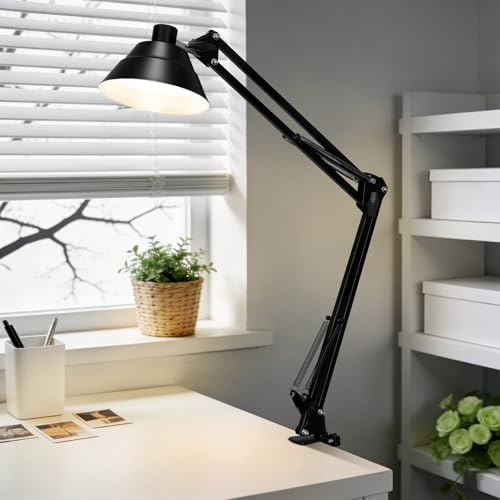
Choose a lamp head that rotates at least 180 degrees and tilts 90+ degrees to accommodate different screen heights, monitor positions, and sitting posture changes throughout your workday. If you alternate between sitting and standing (as recommended in ergonomic best practices—20 minutes standing per hour), your lamp angle will need to adjust accordingly to maintain optimal illumination without creating shadows on your keyboard. Limited positioning flexibility often forces users to adopt awkward neck angles to see their work, defeating the purpose of proper ergonomic setup.
Dimming Controls and Integration with Your Workspace
Tactile dimming buttons or touch controls are more accessible than phone apps if you need to adjust lighting quickly during focus work; look for lamps with memory settings so your preferred brightness level is automatic. If you use multiple monitors or a standing desk converter, ensure the lamp's reach and rotation can cover your entire work surface without repositioning. A lamp that requires constant adjustment will become annoying and eventually go unused, leaving you with inadequate task lighting that leads to squinting and postural compensation.
Frequently Asked Questions
Can I really attach a lamp to any monitor arm?
Not safely—your monitor arm needs at least 1–2 pounds of unused weight capacity above its current load (monitor + stands). Overloading causes gradual sagging that misaligns your screen and forces you into forward head posture within weeks. Always check the arm's manual for maximum supported weight before purchasing a lamp.
What's the best lamp brightness for desk work without eye strain?
Aim for 500–1000 lux on your work surface; this is roughly equivalent to 30–50 watts of LED output depending on the lamp design. Brightness should be 3–5 times higher than ambient room light to reduce contrast glare and prevent your pupils from over-dilating, which causes eye fatigue. Dimmable lamps let you adjust based on time of day and task—lower brightness for email and meetings, higher for detailed design or reading work.
Should I choose warm or cool white light for my desk lamp?
Warm white (2700–3000K) is best for late-afternoon and evening work because it doesn't suppress melatonin and won't disrupt your sleep schedule if you work in the evening. Neutral white (3500–4000K) is ideal for morning and midday tasks when you need alertness and color accuracy. Cool white (5000K+) should be avoided except for high-precision tasks, as research shows it increases eye strain and digital eye fatigue after 2+ hours.
How do I prevent glare and shadows when mounting a lamp on my monitor arm?
Position the lamp 45 degrees to the side of your work surface rather than directly overhead or behind the monitor—this minimizes screen glare and prevents shadows on your keyboard. Adjust the lamp head downward at approximately 30–45 degrees so light hits your desk rather than bouncing toward your eyes. If you see your reflection in your monitor, reposition the lamp slightly until reflections disappear.
What if my monitor arm already has a limited weight capacity?
Consider a desk lamp with a separate stand or a floating clamp-mount lamp designed for keyboard trays instead of monitor arms. Alternatively, mount a lightweight articulating arm (under 8 ounces) to your monitor arm and attach the lamp to that secondary arm. This distributes weight more evenly and prevents the monitor arm from destabilizing.
Can I use a monitor arm lamp with a standing desk converter?
Yes, but you'll need a lamp with wide tilt and swivel range (at least 180-degree rotation and 90-degree tilt) to maintain proper lighting when your monitor height changes between sitting and standing positions. Test that the lamp clears your standing desk's height adjustment range—most standing converters raise surfaces 6–12 inches, and your lamp must reposition accordingly. Many users prefer lamp arms mounted to desk surfaces rather than monitor arms when using standing converters, as this provides more stable, predictable lighting throughout the height range.
Is flicker-free technology really necessary?
Yes—older non-flicker-free lamps cycle at 50–120Hz, which is below the fusion frequency threshold; your brain perceives this as subtle flicker that triggers eye strain and headaches even if you don't consciously notice it. Most modern LED lamps are flicker-free by default, but budget models and older fluorescent fixtures may still flicker noticeably. If you work 6+ hours daily at your desk, investing in a certified flicker-free lamp reduces the risk of visual fatigue by approximately 40% according to occupational lighting research.
Conclusion
Mounting a desk lamp on your monitor arm is a practical ergonomic upgrade when done correctly—the right lamp improves task lighting, reduces eye strain, and supports better posture by eliminating shadows that force you to lean forward or twist your neck. Prioritize weight compatibility, color temperature flexibility, and adjustability over flashy features, and always route cables to keep your desk surface clear and your attention focused on work.
Your lighting setup is as important as your chair and desk height for long-term comfort—invest in a quality, dimmable, flicker-free lamp with genuine articulation, and you'll notice reduced fatigue and improved focus within the first week.


